Description
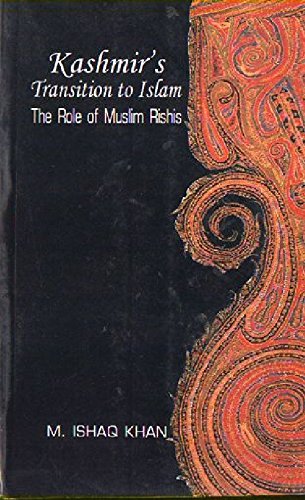
Kashmir’s Transition to Islam breaks fresh ground in historical research. Based on a critical and empathic understanding of Sanskrit, Arabic, Persian, and Kashmiri sources, this significant work provides a profound critique of Orientalist scholarship against the background of an historical enquiry into the processes of Islamization and its dynamics in relation to the role of Muslim Rishis (Kashmiri Sufis).
Professor Ishaq Khan brings together multiple perspectives—historical, sociological, and religious. The crux of his compelling argument is that Islam is not merely a matter of theological propositions, but also a historical realization: realizing the Oneness of Allah by total surrender, dedication, service, and above all, self-sacrifice for the good of humankind.
The Rishi movement is an integral component of the process of Islamization that started in the picturesque Valley in the wake of the introduction of Sufi orders from Central Asia and Persia in the fourteenth century. The author particularly focuses on the paradox and tension that the Kashmiri Brahmanic society experienced as a result of the Rishi’s advocacy of virtues such as self-imposed poverty, identification with the poor and the downtrodden, and, crucially, their staunch opposition to the rigid caste system.
A significant feature of the book is a perceptive analysis of legends and miracles associated with Muslim Rishis. The author advocates looking at history from a fresh point of view, arguing in favour of studying the history of human civilization in its totality, involving a deep interaction between religion and society. He masterfully demonstrates that the history of human civilization cannot be studied in watertight compartments of matter and faith. The present work is therefore highly worthy of attention and holds immense interest for a wide range of readers, rather than merely for specialists.
Table of Contents:
Preface to the Third Edition
Preface to the Paperback Edition
Preface
Introduction
I. Conceptual Framework of Conversion to Islam
II. The Historical Background of the Rishi Movement
III. Socio-Religious Milieu of Shaikh Nuruddin Rishi
IV. Shaikh Nuruddin’s Religions Career and its Social Impact
V. Religious Thought of Shaikh Nuruddin
VI. The Attitudes of the Sufi Orders Towards the Rishi Movement
VII. The Rishis and Conversion to Islam
VIII. The Societal Dimensions of Miracles and Legends
IX. Epilogue
Appendices:
(A) Genealogy of Shaikh Nuruddin
(B) Genealogy of Sayyid Ali
(C) Women Sufis of Kashmir
(D) A Note on Risala-i-Lahmiyya
(E) Khat-I Irshad of Sayyid Muhammad Hamadani
(F) Elegy of Sham Ded
Glossary / Bibliography / Index
About the Author:
Mohammad Ishaq Khan is Professor of History at the University of Kashmir. Formerly the Leverhulme Senior Fellow at the Oxford Centre for Islamic Studies, Dean Faculty of Social Sciences, and Dean Academics at Kashmir University, he is currently working on a Biographical Dictionary of Sufism in South Asia. He is the author of History of Srinagar, 1846-1947: A Study in Socio-Cultural Change; Perspectives on Kashmir: Historical Dimensions; Experiencing Islam, and numerous research articles published in learned journals of international repute.
Kashmir’s Transition to Islam: The Role of Muslim Rishis
By Mohammad Ishaq Khan
Book Specifications:
Category: History / Islamic Studies & Sufism
Publisher: Manohar Publishers
Language: English