Description
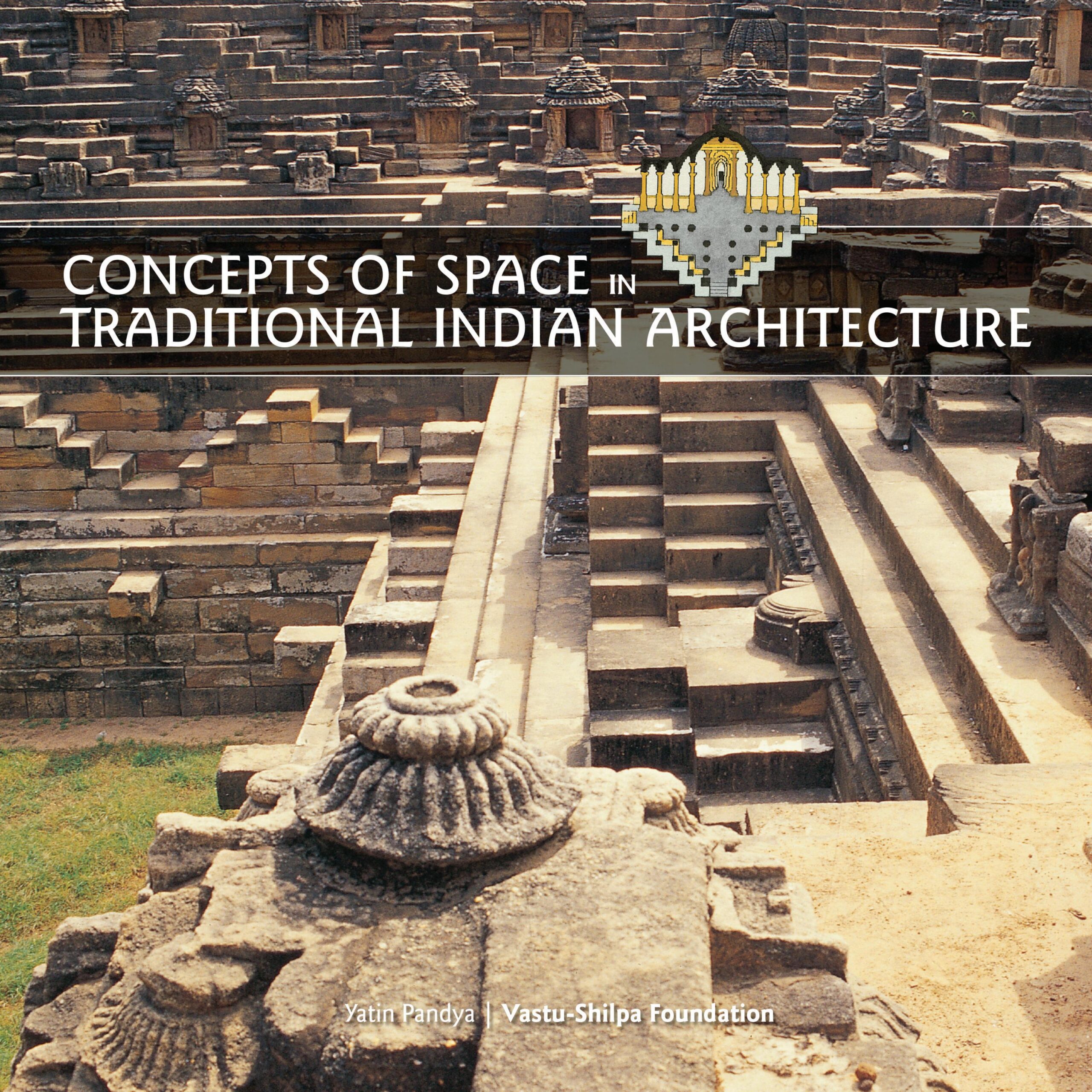
What makes historic architecture awe-inspiring? Why have architectural masterpieces retained their immense vitality after so many centuries? Concepts of Space in Traditional Indian Architecture attempts to answer these profound questions by decoding the spatial qualities and organizational principles that render India’s heritage monuments truly timeless.
The author begins by outlining fundamental Indian philosophical and ideological tenets that shape spatial design: the cyclical notion of time, the duality of existence, the concept of a ‘world within a world’, and the idea of opposites as counterpoints. He deeply explores the role of semiotics in providing visual architectural clues and emphasizes kinesthetics—the changing perception of space while a person is in movement. These design principles are examined as universal dictums for space organization, exemplified across a range of traditional Indian architectural marvels.
The core of the book is a detailed, graphic analysis of five distinct architectural masterpieces:
The ingenious Rudabai Stepwell at Adalaj, near Ahmedabad
The Kailash Temple at Ellora, representing the pinnacle of rock-cut architecture
The Sun Temple of Modhera, with its magnificent water-tank
The City Palace of Udaipur, an organic complex built over four centuries
The Sarkhej Rauza in Ahmedabad, celebrated for its austere beauty and dynamic campus design
This study goes beyond mere description. Each site is brought to life with a wealth of visual materials, including photographs, architectural plans with analytic overlays, and volumetric constructs. Unique miniature-style reproductions reconstruct the environmental and experiential qualities of the spaces, successfully unraveling the inherent virtues of traditional Indian architecture and proving their relevance in today’s modern world.
Table of Contents:
- Acknowledgements
- Prologue
- The Birth of a Princess
- “Bombay, the Beautiful”
- “Parsi kya cheez hai?”—”What is a Parsi?”
- The Birth of a Nation
- The World of Black and White
- Euphoria and Undelivered Promises
- “A New Phenomenon among this Rough Crowd”
- A Home Away from Home
- Moving On
- Homai Kabadiwala and Friendly Ghosts
- Glossary
- References
About the Author: Yatin Pandya is a practising architect, scholar, and academician. He has been actively involved in architectural research as the associate director of the Vastu-Shilpa Foundation for Studies and Research in Environmental Design in Ahmedabad. A visiting faculty member at the Centre for Environmental Planning and Technology (CEPT), Pandya obtained his M.Arch from McGill University, Canada. He is the recipient of numerous national and international awards and has authored various publications on design theory, habitat design, and urban planning.
Concepts of Space in Traditional Indian Architecture By Yatin Pandya
Book Specifications:
- Category: Architecture / Heritage & Design
- Pages: 148 pages
- Illustrations: 148 photographs and 463 illustrations
- Dimensions: 9 x 9″ (229 x 229 mm), Softcover (SC)
- ISBN: 978-81-89995-75-1
- Date of Publishing: 2005, 2013, 2015, 2016, 2023